EN
 ES
 PT
What Was Decided at the COP17 Biodiversity Conference?
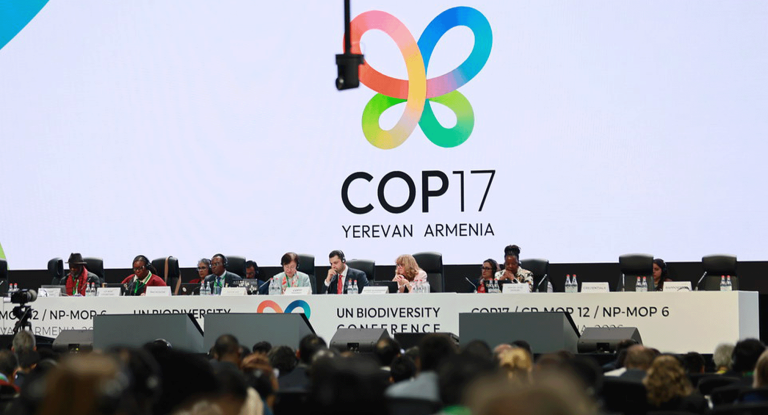
Image credits: Flickr – Official COP17 Web
The 2026 UN Biodiversity Conference (COP17) took place from October 19 to 31 in Yerevan, Armenia. The meeting brought together experts, activists, and decision-makers to discuss topics such as progress toward the goals of the Kunming-Montreal Global Biodiversity Framework (GBF), adopted in 2022 at COP15, and achieving tangible results for nature.
Global Review of the GBF
In one of the most anticipated moments of the conference, countries reached an agreement on the first assessment of progress toward the 2030 targets, known as the GBF’s “global review.” In a decision considered less controversial than other areas of negotiation, countries acknowledged that they are not on track to achieve the 23 agreed-upon targets.
Discussions in Armenia revealed two perspectives on the issue: some stakeholders advocated for very strong language and high ambition regarding what countries should do, while others argued that the main problem with implementation is that countries lack the means to do so, as noted by WWF expert Kirsty Leong in an interview with Carbon Brief.
As a result of this debate, the final text encourages parties to accelerate and be more ambitious in implementing the GBF, taking into account local realities and their respective National Biodiversity Strategies and Action Plans (NBSAPs), while recognizing that developing countries need more support to achieve this goal.
GBF Target 15: Discussions Continue Outside the Official Agenda
Growing market demand for a global standard — including the definition of measurable metrics for nature — continues to gain momentum, even though there is no clear definition of what form such an instrument should take: whether it should be a best practice or a full-fledged standard.
On October 22, during COP, the International Sustainability Standards Board (ISSB) launched a public consultation on nature-related disclosures, supported by the Task Force on Nature-related Financial Disclosures (TNFD) and IFRS S1.
Compliance with Target 15 of the global framework requires companies and financial institutions to periodically assess and disclose their material issues related to nature — including impacts, dependencies, risks, and opportunities—while progressively reducing negative risks and impacts. Despite the challenge of integrating this agenda with the climate agenda and defining robust and measurable metrics, the TNFD framework remains, according to the ISSB, valid for preparing disclosures aligned with IFRS S1.
As one of the key highlights of this agenda, the Nature Positive Initiative (NPI) launched the State of Nature Indicators and Metrics, establishing four core metrics focused on ecosystem extent, environmental condition, and species populations. Additionally, the TNFD, NPI and the Science Based Targets Network (SBTN) announced the integrated alignment of nature frameworks, joining forces to define a common measurement framework that connects assessment, target setting, and disclosure, with the goal of advancing progress toward Target 15.
In short, for the business and financial sectors, it is clear that regulatory pressure continues to come from national standards and market trends, even though it is not a requirement under the CBD.
Learn how to participate in the public consultation on nature-related disclosures.
The Yerevan Pathway
The “Yerevan Declaration: Acting for Nature” was released before COP17 officially began on October 16, at the conclusion of the plenary session of the Leaders for Nature Summit. The document reaffirmed the commitment to implementing the GBF and called for ways to put it into practice.
In response, the Yerevan Pathway was adopted on October 31, during the final stage of COP17. The document identifies priorities for action through 2030 and areas where progress will need to be accelerated. These include combating subsidies and incentives harmful to nature; increasing support for developing countries; strengthening implementation mechanisms; and reviewing their strategies and action plans, among other actions.
Financing
Financing was one of the most controversial issues at COP, with countries at odds over expanding the group of contributors and over the best way to ensure that conservation funds reach the people who protect ecosystems on the ground.
Presented during the Conference, the global report noted that developed countries have failed to meet their commitment to mobilize at least $20 billion per year by 2025. Delegates cited a drop in international aid and a sharp 27% decline in environmental financing for the period between 2026 and 2030.
The final decision acknowledges that contributions from more parties, including developing countries, would improve resource mobilization, but it avoided establishing rules to expand the list of donors. The text clarifies that no country will be included on the list without an invitation and confidential consultation, to ensure explicit consent. Those interested in joining the list may express their interest before COP18, which will take place in Ecuador in 2028.
As part of the negotiations, a financial mechanism for nature after 2030 was also established under the governance of the COP (a long-standing request from developing countries), but the decision on its form — whether it will be a new fund or will use existing arrangements—was postponed until the next session of the conference.
Cali Fund
Regarding the Cali Fund, countries maintained the voluntary contribution rates (0.1% of revenue or 1% of profit), established distribution rules allocating half of the resources to indigenous peoples and local communities, and deferred most of the pending issues to COP18. The outcome was considered limited, as the fund has received just over $10,000 to date.
Final Assessment: what was the outcome of COP17?
According to Luana Cordeiro, Nature-based Solutions Manager at WayCarbon, the outcome of the Conference was a modest step forward. “COP17 concluded its proceedings marked by the contrast between progress on pragmatic technical agreements and political gridlock on the central issues of financing and governance. The result is a strengthened process, but one that still lacks the necessary means to accelerate action on the scale required by the 2030 targets,” she says.
References
- Yerevan declaration Taking Action for Nature
- Carbon Brief – COP17: Key outcomes agreed at the UN biodiversity conference in Yerevan
- CBD – UN Biodiversity Conference charts Yerevan Pathway to accelerate global action for nature
- Carbon Brief – Cropped 28 October 2026: ‘Slow progress’ at COP17