
 EN
EN  ES
ES PT
PTCOP30: Key Decisions and Impacts on the Private Sector
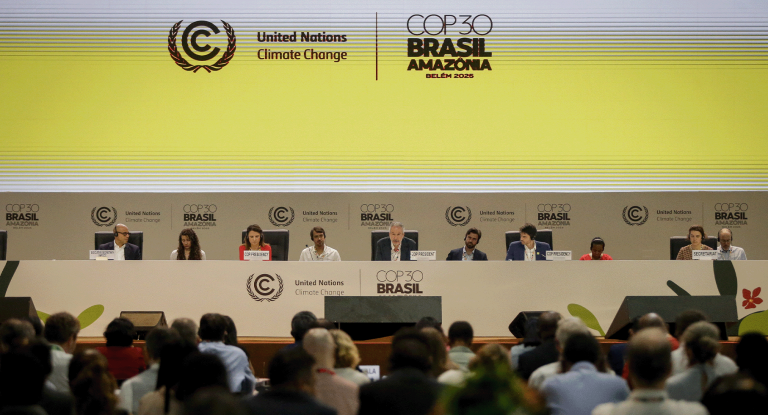
The final text of the 30th United Nations Conference on Climate Change (COP30), held in Belém (Brazil), was published on Saturday (22), one day after the official closing date, a practice that has been recurrent in recent editions of the COP, due to the complex challenge of finding consensus among the 195 countries. According to the Brazilian presidency, 29 decisions were made on topics such as just transition, adaptation financing, trade, gender and technology.
WayCarbon participated in 15 panels as a moderator or speaker, represented by Felipe Bittencourt, (CEO), Henrique Pereira (COO), Keyvan Macedo (Head of Global Business), Bruna Araújo (Sustainable Finance Manager), Melina Amoni (Climate Risk and Adaptation Manager) and Nathalia Pereira (Sustainable Finance Coordinator). Lauro Marins, Head of Consulting and Digital Solutions, also followed the conference negotiations remotely. Below, we bring you COP30 key decisions with the main insights of our experts.
Fossil fuels
Even with a pre-event period marked by questions about the city’s infrastructure, the Brazilian presidency’s effort to speed up negotiations and leave the edition with concrete results was noticeable. However, the main claim of experts and scientists, the definition of a Road Map Away from Fossil Fuels, did not make it into the final text, mainly due to resistance from countries such as Russia, Saudi Arabia and Nigeria, which claim to depend on these inputs economically.
Despite this, the movement that began in Belém, with the support of more than 80 countries and the appeal of journalists present, culminated in the creation of a voluntary international conference to discuss the issue, led by Colombia and the Netherlands. The meeting is expected to be held on April 28 and 29, 2026, in Santa Marta, Colombia.
In addition, an Energy Transition Acceleration plan was announced, a global commitment for 90% of the added electricity capacity to be renewable. The plan also involves encouraging the decarbonization of “hard to abate” sectors, such as maritime transport and aviation, with specific targets for sustainable fuels.
Global Stocktake and NDCs
In terms of governance and transparency, the final text reinforced the role of the Global Stocktake as a monitoring mechanism. The Stocktake is a periodic review process, which checks the world’s collective progress towards climate goals every five years. The importance of greater integration between climate data, corporate reporting and national policies was also highlighted.
Regarding the Nationally Determined Contributions (NDCs), which are monitored by the Global Stocktake, the Brazilian presidency reinforced the importance of more ambitious goals. Only 122 countries, about 60%, had submitted updated NDCs by the end of the edition, according to Agência Brasil. In the final text, countries were also encouraged to anticipate the update of their goals by 2027, including the themes of just transition, adaptation, gender equality and economic resilience.
When following the discussions on mitigation of the Brazilian productive sectors, Henrique Pereira assessed that it was clear that Brazil’s differentials in the low-carbon economy will not be enough to align national emissions with the goals of the Paris Agreement. “Unlocking innovative technologies on a commercial scale; ensure the supply of renewable, competitive and secure energy; ensure the financeability of productive transformations; and advance in the adoption of a carbon market in Brazil will be fundamental,” he recommended.
Climate finance
Another issue that recorded progress was the Global Climate Finance Target. The “Baku to Belém Roadmap” defined a progressive increase in financing for developing countries, reaching US$ 1.3 trillion per year by 2035. This goal is considered a leap from previous commitments, which were around US$ 100 billion per year. A two-year work programme on climate finance was also proposed. “I see as highlights the cases of implementation of financial mechanisms presented, which transform ambition into real capital flow. We saw experiences that can be replicable and scalable, contributing to the resource reaching where it is needed”, explained Bruna Araújo.
Adaptation in focus
And the expected focus on the climate adaptation theme, which was previously dealt with in a secondary way at the COPs, has indeed occurred. Parties approved 59 voluntary indicators to monitor progress against the Global Adaptation Target (GGA), on topics such as water, food, health and infrastructure. The indicators integrate cross-cutting issues such as finance, technology and capacity building.
The decision also involves a work plan focused on improvements and implementation for the next two years. Although the initial 100 indicators were not approved, the announcement was considered a breakthrough by experts, because it makes the topic more tangible.
COP30 key decisions for the private sector
Lauro Marins lists two points that he considers relevant for the private sector: “The revision of the NDCs, in 2027, will require countries to have more ambition (by aligning with 1.5º C) and robustness, even by including topics such as just transition and adaptation. Thus, especially the most representative sectors among Brazilian emissions, such as agriculture, energy and industry, should be attentive”, he stressed.
The second point listed by the expert is that we only have about four years to cut emissions by 50% (by 2030), following the alignment with the Paris Agreement. “In this context, financial flows for low-carbon investments should and need to intensify in the coming years. Unfortunately, we should feel the impacts of the changes more from now on, so the need for action will be more evident,” said Marins.
In an exclusive event for WayCarbon clients, Melina Amoni stated that COP30 had different characteristics from previous ones, featuring unprecedented participation from civil society and the Brazilian private sector. “I see this news in a very positive way. The business sector has ceased to be a complementary actor to assume a leading role. The COP cannot solve all the problems on the agenda, so companies and investors have relevant functions such as implementation, resource mobilization and acting in public-private partnerships, with a focus on mitigation and adaptation projects,” she said.
Final balance
Felipe Bittencourt pointed out, in his assessment of the meeting, that COP30 showed that multilateralism remains the only possible bridge between ambition and reality. “It was not a conference of major disruptions, but of incremental advances that matter and that build the foundations to transform commitments into implementation. In an increasingly vulnerable world, strengthening governance, trust and cooperation is as essential as funding solutions. We continue to work so that the decisions of Belém become real impacts for countries, cities and companies”, he concluded.