
 EN
EN  ES
ES PT
PTThe adaptation agenda and the private sector
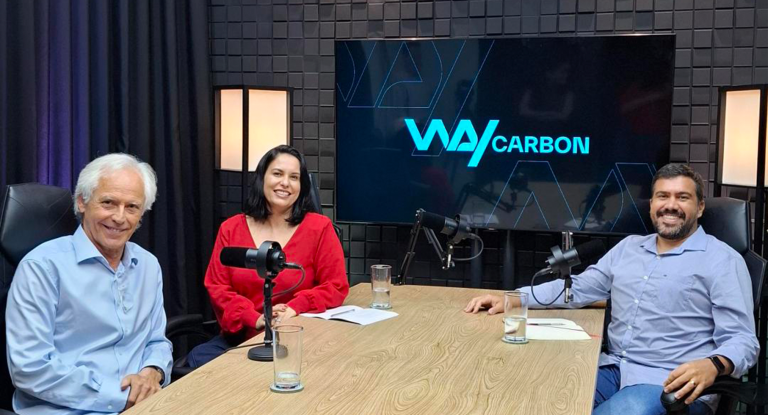
Adaptation to climate change was one of the main topics discussed at COP30 and was also the subject of the 14th episode of WayCarbon Talks. The guests were Sergio Margulis, Senior Research Associate at the International Institute for Sustainability (IIS) and partner consultant at WayCarbon, and Melina Amoni, our Climate Risk and Adaptation Manager. The host of the videocast is Lauro Marins, Head of Consulting and Digital Solutions at WayCarbon.
In the debate, the experts addressed topics such as: the differences and synergies between mitigation and adaptation; the challenges in making the theme tangible; the financing impasses for this type of initiative in the context of COP30; the role of the private sector in the agenda; in addition to the importance of rules and regulations.
Mitigation vs. Adaptation
Starting the conversation, Sergio Margulis explains that the term mitigation refers to the effort to reduce greenhouse gas (GHG) emissions, while adaptation implies that, given that the climate is changing, we need to promote actions to adapt to this new reality.
“Of course, global warming will only be solved with mitigation, but there is no point in reducing emissions and, in this period until reaching Net-Zero, the world has suffered a huge amount of impacts, as occurred in Rio Grande do Sul (Brazil) in 2024. In short, mitigation is important to solve the problem, but to preserve social, economic and environmental well-being, we need adaptation,” he says.
Margulis states that another fundamental difference that explains why mitigation actions receive greater attention and investments, in general, is the fact that reducing emissions is in everyone’s interest, regardless of which country makes the effort. On the other hand, adaptation mainly solves local problems.
Melina Amoni complements, remembering that mitigation is more tangible, has metrics and methodologies, which allows you to visualize what should be done more clearly. “In addition, adaptation is often seen as a cost and mitigation a little more as an opportunity, in which companies and cities can see a clearer return. An example of an adaptation action can be to invest in a work that prevents flooding, which brings a great benefit to the population of a given neighborhood, but the impact is not visible globally”, evaluates Amoni.
However, she points out that efforts to synergize mitigation and adaptation are needed, considering multiple benefits. As an example, the specialist cites Nature-Based Solutions. “Mangrove restoration contributes to mitigation through its high capacity for carbon capture and storage, known as ‘blue carbon’. At the same time, these ecosystems act on adaptation, functioning as natural barriers against storms, coastal erosion and sea level rise, protecting vulnerable communities and infrastructure near the coast”, he explains.
During COP30, held in November in Belém, the agenda made progress with the approval of 59 voluntary global indicators to measure countries’ progress on the topic, in alignment with the Global Goal on Adaptation (GGA). The text established guidelines for the use of these indicators and details next steps for operationalization, which should be addressed over the next two years, in the document called “Belém–Addis Vision”, to then create possible paths for legal obligations.
Why is the subject of interest to the private sector?
Lauro Marins says that, in his practical experience, governments move at a very different speed from the private sector on this issue. “At WayCarbon, we work with both, and when it comes to adaptation, there is faster action from the private sector,” he says.
Unlike the public sector, which does not have penalties linked to climate risks and adaptation, the private sector has obligations such as IFRS (International Financial Reporting Standards), Amoni adds. Following the 2023 guideline of the CVM (Securities and Exchange Commission of Brazil), publicly traded companies will need to disclose impacts and risks related to sustainability and climate as of 2027, considering the base year 2026. “This decision makes companies have a more specific look at risk management and the implementation of adaptation initiatives, which is now seen as an opportunity for competitiveness and market positioning”, he analyzes.
The specialist also says that, in this context, companies have been looking more at value chains, their surroundings and the communities affected by their operations. “We work with several organizations linked to road infrastructure and the surroundings of the roads, in general, have the presence of extremely vulnerable populations. In this regard, I see the business sector working alongside the public sector in adaptation actions to reduce this vulnerability. The government creates the environment and the private sector has the role of financing and innovating”, he concludes.
Watch the full episode (Audio in Portuguese, activate automatic subtitles).