
 EN
EN  ES
ES PT
PTStrategic challenges of the year: climate finance and regulatory landscape
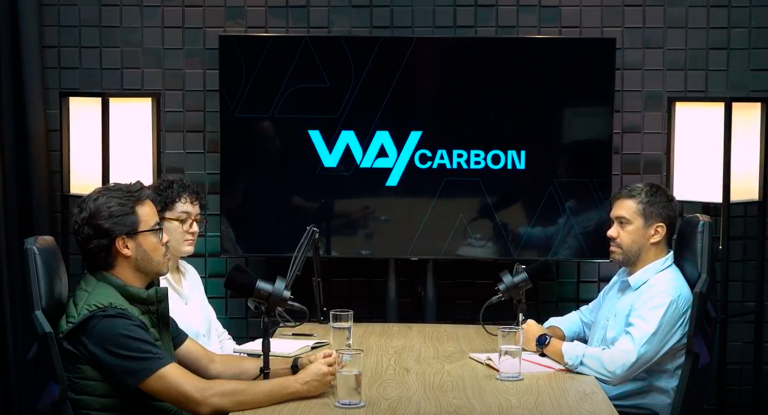
The 16th episode of WayCarbon Talks explored the strategic challenges that await companies in 2026 in relation to climate finance, regulatory landscape, and transition. The debate was attended by Henrique Pereira (COO) and Nathalia Pereira (Sustainable Finance Coordinator), under the mediation of Lauro Marins (Head of Consulting and Digital Solutions).
Introducing the conversation, Henrique Pereira pointed out that some challenges are already given, mainly from the regulatory agenda, resulting from the objectivity that the climate and sustainability issues have acquired, but which also reflect a challenging economic context. “The agenda needs to be integrated with the business and the movement needs to start quickly. Financing is an opportunity and there are many innovations emerging in this aspect, but accessing it will require preparation,” said the executive.
IFRS Standards
Experts indicate that IFRS standards, which will be mandatory for publicly traded companies from 2027, should be among corporate priorities. “We learned in projects of this scope throughout 2025 that there is certainly a concern with access to reliable data for reporting, but it is a less complex challenge to overcome than the challenges of governance and internal structuring of companies. In our projects, we have been playing the role of bringing the controlling and compliance teams closer to the sustainability teams, who are not used to working together “, explains Pereira.
The structuring of governance and internalization of the agenda requires the evolution of organizational competencies. The goal is for knowledge about sustainability to not be restricted to one area and to be applied effectively to the financial, governance, and controlling contexts. “Finally, another very important strategic element in the process is risk appetite and how this reflects on business decision-making,” adds the executive.
Climate finance
Regarding the financial market, Nathalia Pereira points out that something to be observed in this and the coming years is that, as banks take ownership of the application of IFRS, they will have an increasingly detailed and rigorous look at customers’ climate risks. “If the financial system as a whole is better able to price and manage risks to which the portfolio is exposed, we will naturally have more structured financial flows to more resilient companies and to projects with greater climate impact,” he explains.
According to the expert, the challenge is to connect the allocation of bank resources with good projects. “For banks, there will be a procedural complexity, of internal training, involving the integration of climate risks and opportunities, and a much more robust and sophisticated ROI assessment than was seen until then. On the companies’ side, there will be a need to demonstrate that a certain decarbonization or resilience project is climate-desirable, but it is also rational from the point of view of the company’s financial maturity,” he says.
Climate transition plans
Following the conversation, the guests point out that the climate transition plan is the point that unifies the challenges discussed. The plan involves actions structured in components of decarbonization, response to risks and opportunities, contribution to the transition, as well as financing possibilities for the actions. “The transition language is useful to account for the complexity of the agenda, because the projects and actions are now in the same long-term positioning package of the companies,” says Nathalia.
For Henrique Pereira, this initiative helps to land the components of the climate strategy. “When you have an economy with no signs of recovery, high interest rates and the cost of capital ‘at the ceiling’, the global perception of risks becomes more unpredictable. Therefore, the debate on decarbonization today only makes sense within a logic of transition,” he concludes.
Watch the full episode (audio in Portuguese, enable automatic subtitles).